Writing · Essay
What a small business website actually needs
Most small business sites have too much on them and not enough of what customers came for. Here's what matters, what can wait, and why one page is often enough.
Most people land on a small business website with one question. Can you help me, and how do I reach you? Everything on the page either answers that fast or gets in the way.
I build sites for small businesses, and the ones that work have less on them than you’d think. Here’s what I put on every one, what I leave off, and why.
Who Is Looking
Picture who’s actually on your site. Someone on their phone, probably in a parking lot or on a couch, who just searched “tree service near me” or tapped your name in Google Maps. They have a few other tabs open. They’re comparing.
They aren’t going to read your story. They want to know four things:
- Do you do the thing I need?
- Are you near me?
- Are you open, or when can I reach you?
- Can I trust you?
If your site answers those in the first screen, you win the call. If they have to dig, they hit back and call the next one.
What Goes on the First Screen
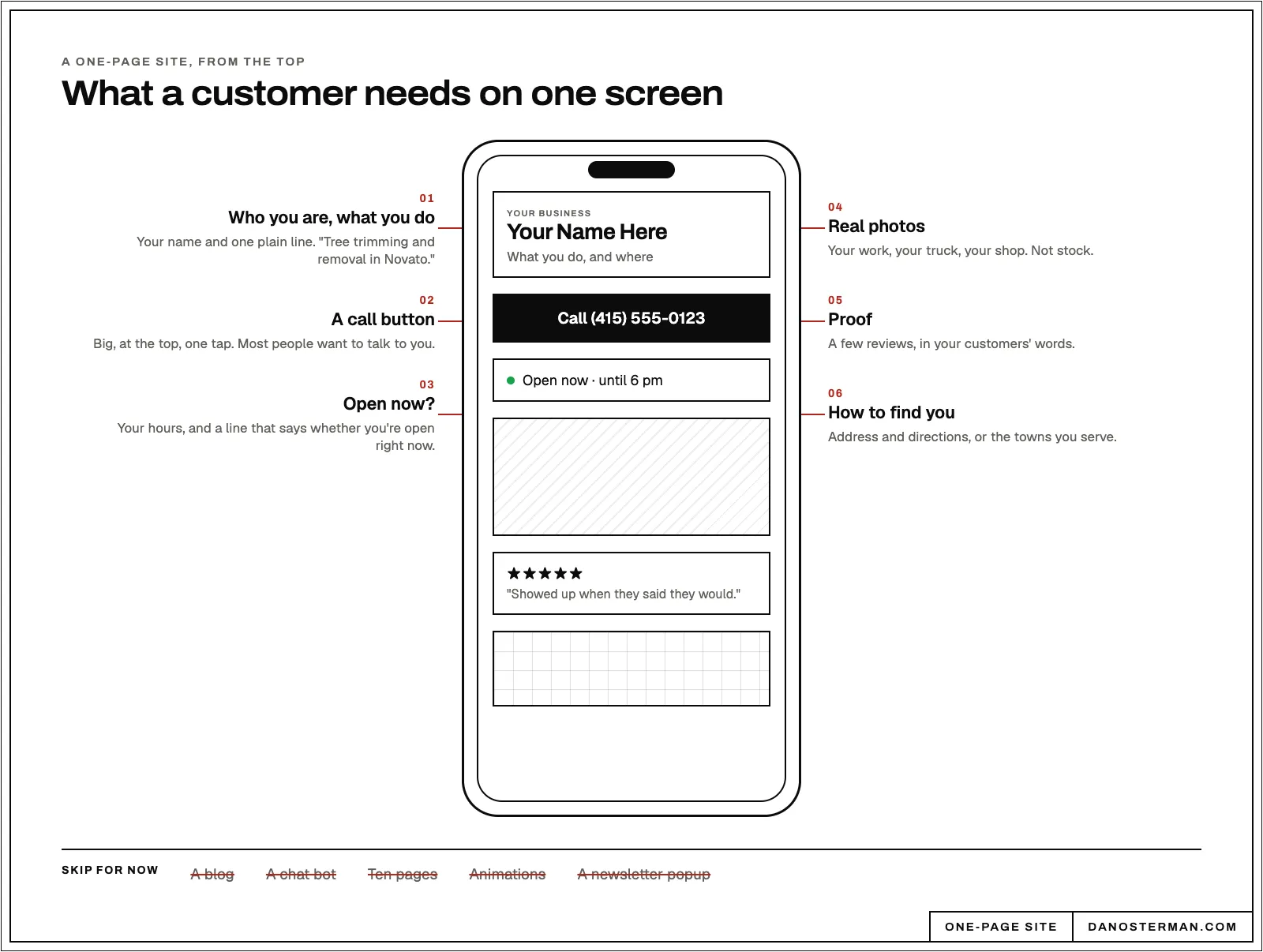
1. Who you are and what you do. Your name and one plain line. “Tree trimming and removal in Novato.” Not a slogan. A customer should know in two seconds if they’re in the right place.
2. A call button. Big, near the top, one tap. Most local customers want to talk to a person. Make that the easiest thing on the page. If you’d rather get texts or form requests, put that button here instead. Just pick one and make it obvious.
3. Your hours, and whether you’re open right now. A line that says “Open now, until 6 pm” saves people from calling a closed shop and giving up. It’s a small thing that people notice.
4. Real photos. Your work, your truck, your shop, your team. Stock photos make you look like everyone else. A slightly blurry photo of a real job you did beats a perfect photo of someone you’ve never met.
5. Proof. A few reviews in your customers’ own words. Three good ones are plenty. If you have a license number, an insurance line or years in business, this is a good place for it.
6. How to find you. Your address and a directions link, or if you go to customers, the towns you serve.
That’s it. That’s a website that does its job.
What Can Wait
A blog. Only if you’ll actually write. An empty blog with one post from 2023 looks worse than no blog.
A chat bot. Most small business chat bots answer questions the page should have answered already. Put the answer on the page.
Ten pages. If you do one or two main things, one page is enough. More pages means more places for the important stuff to hide. When you do offer several distinct services, a page for each one starts to make sense, mostly so Google can match each one to the people searching for it.
Animations and video backgrounds. They look great on a fast laptop and slow down a phone on one bar of signal. Speed is a feature.
A newsletter popup. Nobody came to your plumbing site to subscribe to anything.
The Stuff Nobody Sees
A few things matter a lot and don’t show up on the page at all:
- It’s fast on a phone. Most of your visitors are on one. If the page takes more than a couple of seconds, a lot of them are gone.
- Google can read your details. Your name, address, phone and hours are marked up in a way search engines understand. That’s part of how you show up in “near me” searches and in the map.
- AI search can read it too. More people are asking ChatGPT or Google’s AI answers for a recommendation instead of scrolling results. Those tools pull from pages they can read cleanly. Plain text, clear details, no important info hidden inside an image.
- You own it. Your domain is in your name and your content is yours. If you ever leave whoever built it, you take it with you.
Your Google Listing Matters More
This surprises people. For a lot of local businesses, the Google Business Profile does more work than the website. It’s the box with your hours, photos, reviews and a call button that shows up in Maps and on the right side of search.
The website and the profile work together. The profile gets you found. The website is where people go to make sure you’re legit before they call. Keep both up to date and make sure the hours and phone number match. Mismatched details are one of the most common problems I see.
Where I Come In
This is what my One-Page Site is: the six things above, built around your business, fast on every phone, set up so Google can read it. It’s $500 and $29 a month for hosting and care, and it’s usually live in about a week. Bigger sites with a page per service and your Google profile set up together start at $1,500.
You don’t need me to use this list, though. Pull up your own site on your phone right now. Can a stranger tell what you do, call you and know if you’re open, all without scrolling? If yes, you’re in good shape. If not, you know what to fix first.
If you want a second set of eyes on it, send me a note. I’m happy to tell you what I’d change.